The Next Descent
A Practical Guide to Better Diving
Word/Pages: ~40,000 words / ~185 pages
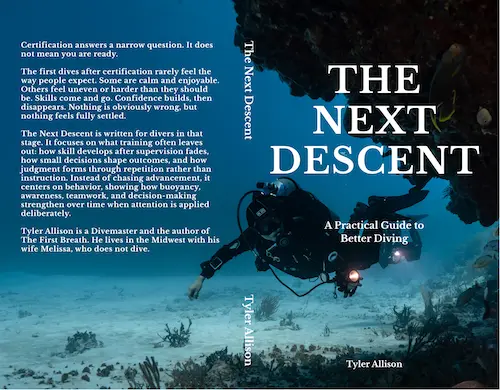
The first dives after certification rarely feel the way people expect. Some are calm and enjoyable. Others feel uneven or harder than they should be. Skills come and go. Confidence builds, then disappears. Nothing is obviously wrong, but nothing feels fully settled.
The Next Descent is written for divers in that stage. It focuses on what training often leaves out: how skill develops after supervision fades, how small decisions shape outcomes, and how judgment forms through repetition rather than instruction. Instead of chasing advancement, it centers on behavior, showing how buoyancy, awareness, teamwork, and decision-making strengthen over time when attention is applied deliberately.
Stage 1 — Understanding What Matters
Introduction
Certification answers a narrow question. Can you complete a supervised dive safely enough to be released into the water with other divers who have done the same. It does not answer the question most people think they are asking, which is whether they are actually ready to dive. That realization usually arrives slowly.
The first few dives after certification tend to feel uneven. Some are calm and enjoyable. Others feel busy or awkward without being dangerous. Comfort comes and goes. Skills work one day and feel unreliable the next. Nothing is wrong. This is simply what it looks like when people move from instruction into independence. This book exists for that stretch.
The Next Descent is written for certified divers who are still finding their footing, usually somewhere between five and fifty dives, when enthusiasm is still there but certainty has not arrived. It assumes you know the basics well enough to get in the water. What it focuses on is what training rarely spends time on: how skill actually develops once supervision fades, how judgment forms through repetition, and how calm, capable behavior is built deliberately rather than hoped for.
Progress in diving is rarely dramatic. It does not happen because of depth, difficulty, or variety. It happens when attention shifts away from simply completing the dive and toward how you are behaving within it. Buoyancy becomes quieter. Breathing settles sooner. Awareness widens. Teamwork stops feeling forced. None of this arrives on schedule, and none of it responds well to shortcuts.
This book is not about becoming advanced. It is about becoming steady. It looks at where early progress actually comes from, why repetition matters more than novelty, how fear and humility shape good judgment, and how early decisions about training and equipment can either support learning or get in the way. The goal is not to accelerate you toward something else. The goal is to help you become more consistent where you are.
Diving rewards patience. It also exposes pretense quickly. The water does not care what you believe you can do. It responds only to what you actually do, repeatedly, when nothing exciting is happening. If you keep reading, you are not committing to a particular path, style, or outcome. You are choosing to approach your dives with intention rather than assumption.
The chapters ahead focus on behavior, mindset, and small decisions that compound over time. They are drawn from real dives, real misjudgments, and gradual improvement, not from idealized progression models. The next descent is not about going deeper.
Chapters
- Certified Is Not the Same as Skilled
- The Road to 50 Dives
- The First Real Mistake
- When Experience Lies to You
- Comfort Is Not the Same as Safety
- What Feels Acceptable
- Buoyancy and Trim
- Breathing and Efficiency
- Movement and Stillness
- The Surface Matters
- Decision-Making Under Ambiguity
- Situation Awareness
- Understanding Proper Weighting
- Predictability Beats Talent
- Solo Thinking in a Buddy World
- Beating a Good Buddy
- Managing Stress and Task Load
- Failure Without Drama
- Knowing When to End a Dive
- The Day You Don't Feel Like Diving
- Dive with Intention
- Evaluating a Course
- When to Take Another Class
- Rent or Own, Local or Travel
- Early Gear Decisions
- Why Carry a Dive Light
- Why Carry a Cutting Tool
- Backup Masks and the Limits of Redundancy
- Redundancy Should Follow Dependency
- When The Water Changes
- Confident, Fear and Humility
- Turning Experience Into Signal
- Your Own Code of Conduct
- The 50-Dive Reflection
- Some Dives are Just Dives
- Staying With the Water